Pantheon AI Governance
Your employees are using AI. Do you know what they’re sharing?
ChatGPT. Claude. Gemini. Copilot. Your employees are using AI to get work done, often through personal accounts and without IT oversight.
But do you know which applications they’re using? What information they’re uploading? Whether they’re following your AI policies?
If you can’t see it, how can you govern it?

What information is being shared with AI?
Financial records. Student information. Customer data. Confidential documents.
Your employees may be sharing sensitive information with AI applications without realizing the risks.

The AI risks you may not see
Unapproved AI applications
Employees may be using AI tools your organization hasn’t reviewed or approved, on accounts you don’t own.
Sensitive information being shared
Financial records, student information, customer data and confidential documents can end up in personal AI accounts, with no audit trail and no way to pull them back.
Policies without enforcement
You may have an AI acceptable-use policy. Without visibility, it’s a speed limit with no radar: everyone knows the rule, and no one knows who’s breaking it.
AI agents without guardrails
Agents and automated workflows may be accessing your systems and data without clearly defined permissions or oversight.
If IT can’t see what’s being shared, how can it protect it?
AI governance takes more than a policy.
Pantheon puts it in place in four steps.
01
Discover
Identify the AI applications in use, by whom and on which accounts, and uncover visibility and data exposure gaps.
02
Govern
Establish clear policies on approved AI tools, acceptable use, and what information can and cannot be shared.
03
Protect
Evaluate and implement the right technology: approved AI your people want to use, plus controls that protect sensitive data and enforce policy.
04
Monitor
Maintain ongoing visibility, alerts and reporting so your governance stays effective as AI keeps changing.
Block the risky path. Pave the safe one.
Blocking personal AI without offering something better just creates workarounds. Real governance gives people AI they want to use, and the visibility to know it’s being used the right way.
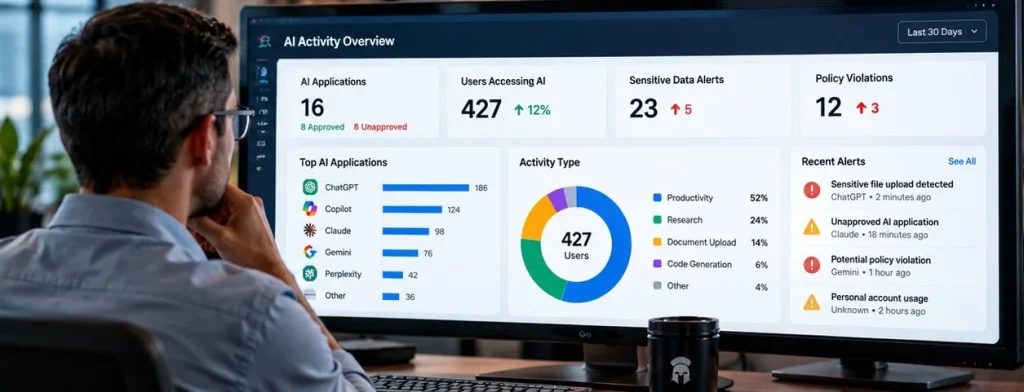
Illustrative example. Visibility turns “we think” into “we know.”
See and control
- Every AI tool in view. Sites, apps and extensions across your organization.
- Personal vs. company accounts. Keep your data on the right side of that line.
- Guardrails for AI agents. What they can access, what they can do, and when a person must approve.
- A complete record. Prompts, responses and agent activity, ready for leadership or an auditor.
Use AI safely
- One approved AI workspace. The leading AI models in one place, so no one needs a personal account.
- Sensitive data masked automatically. Before it ever reaches a model.
- Answers that still make sense. Protected details are restored in the response.
- Rules by role. What each team can share, with which models, tied to the identity system you already use.
Don’t stop AI innovation. Govern it.
AI can transform how your organization operates. But adopting it without visibility and safeguards introduces unnecessary risk. Pantheon helps you find the right balance between productivity, security and control.
Know what’s being used. Control what’s being shared. Govern what’s next.
Before you deploy more AI, understand what’s already happening.

Strategy, implementation and support for organizations where technology carries the mission.
Services
Company
Contract vehicles
- DIR
- TIPS
- OMNIA Partners
- Equalis Group
© 2026 Pantheon Global Solutions LLC. All rights reserved.